{{ 'fb_in_app_browser_popup.desc' | translate }} {{ 'fb_in_app_browser_popup.copy_link' | translate }}
{{ 'in_app_browser_popup.desc' | translate }}
{{ childProduct.title_translations | translateModel }}
{{ getChildVariationShorthand(childProduct.child_variation) }}
{{ getSelectedItemDetail(selectedChildProduct, item).childProductName }} x {{ selectedChildProduct.quantity || 1 }}
{{ getSelectedItemDetail(selectedChildProduct, item).childVariationName }}
Alishan is one of the representative regions for high mountain tea in Taiwan, and our tea gardens there sit at an altitude of 1,250–1,500 meters. The favorable climatic conditions in this area are crucial for tea growth and play an important role in developing the aroma and flavor of Alishan Tea. It is not only a well-known specialty of Taiwan but also a highly regarded premium tea internationally.
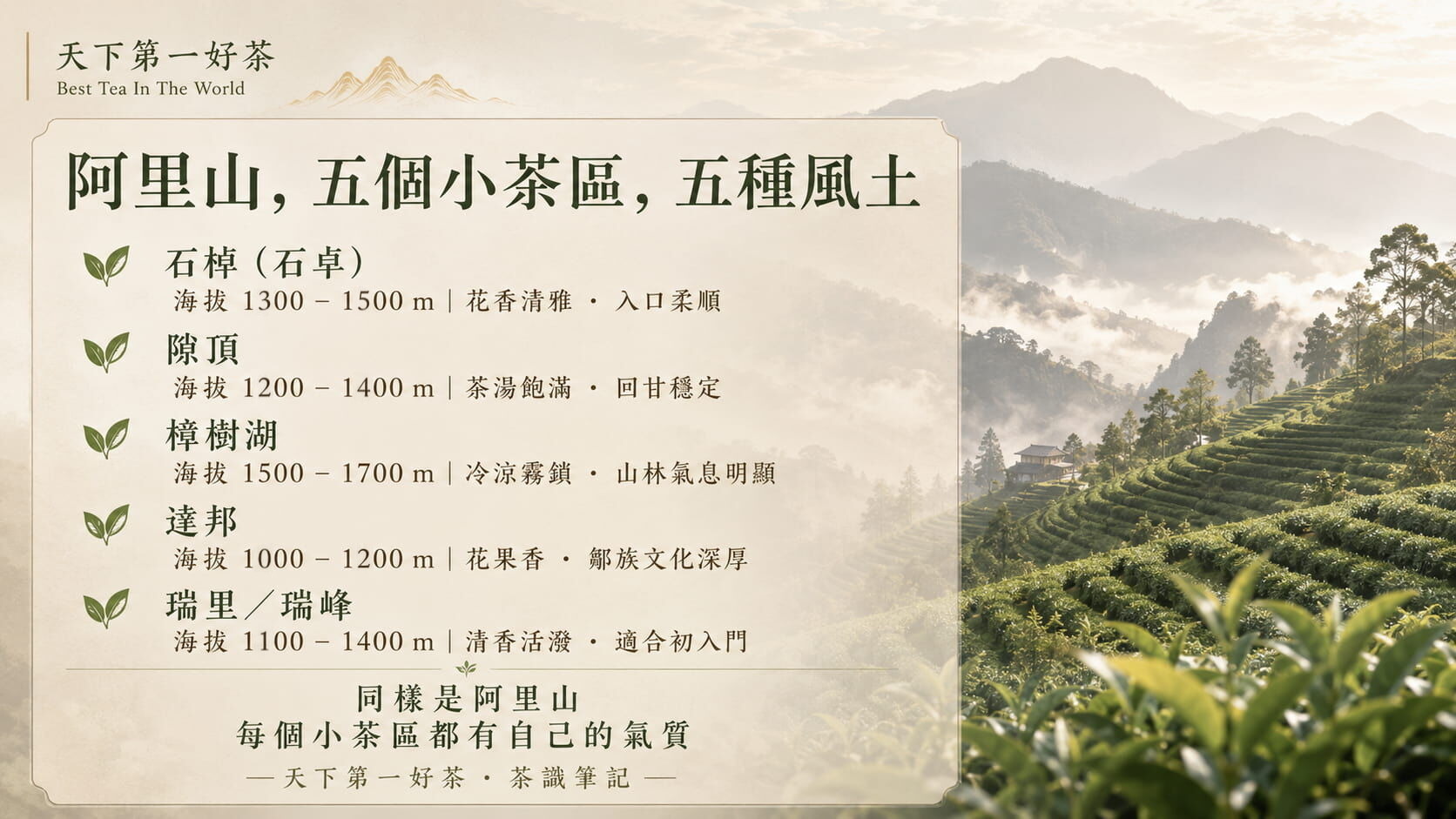
Alishan is not a single tea area but a high mountain tea belt spanning several townships in Chiayi County. Each area has its own altitude, terrain and soil, so each tea has its own character. These are the most representative sub-regions:
| Sub-region | Altitude | Flavor |
|---|---|---|
| Shizhuo | 1,300–1,500m | One of the best-known Alishan areas: a clear floral aroma and a clean, sweet finish. Home of Alishan Zhulu tea |
| Xiding | 1,200–1,400m | Plenty of sun and steady mist: a full-bodied cup with honey-floral notes |
| Zhangshuhu | 1,500–1,700m | Cooler at its higher altitude, so the leaves grow slowly: a crisp cup with strong mountain character |
| Dabang | 1,000–1,200m | Tsou tribal land surrounded by native forest: smooth, with wildflower notes |
| Ruili / Ruifeng | 1,100–1,400m | Famous for its sea of clouds: a fresh, elegant aroma. One of the main areas for Alishan Jin Xuan |
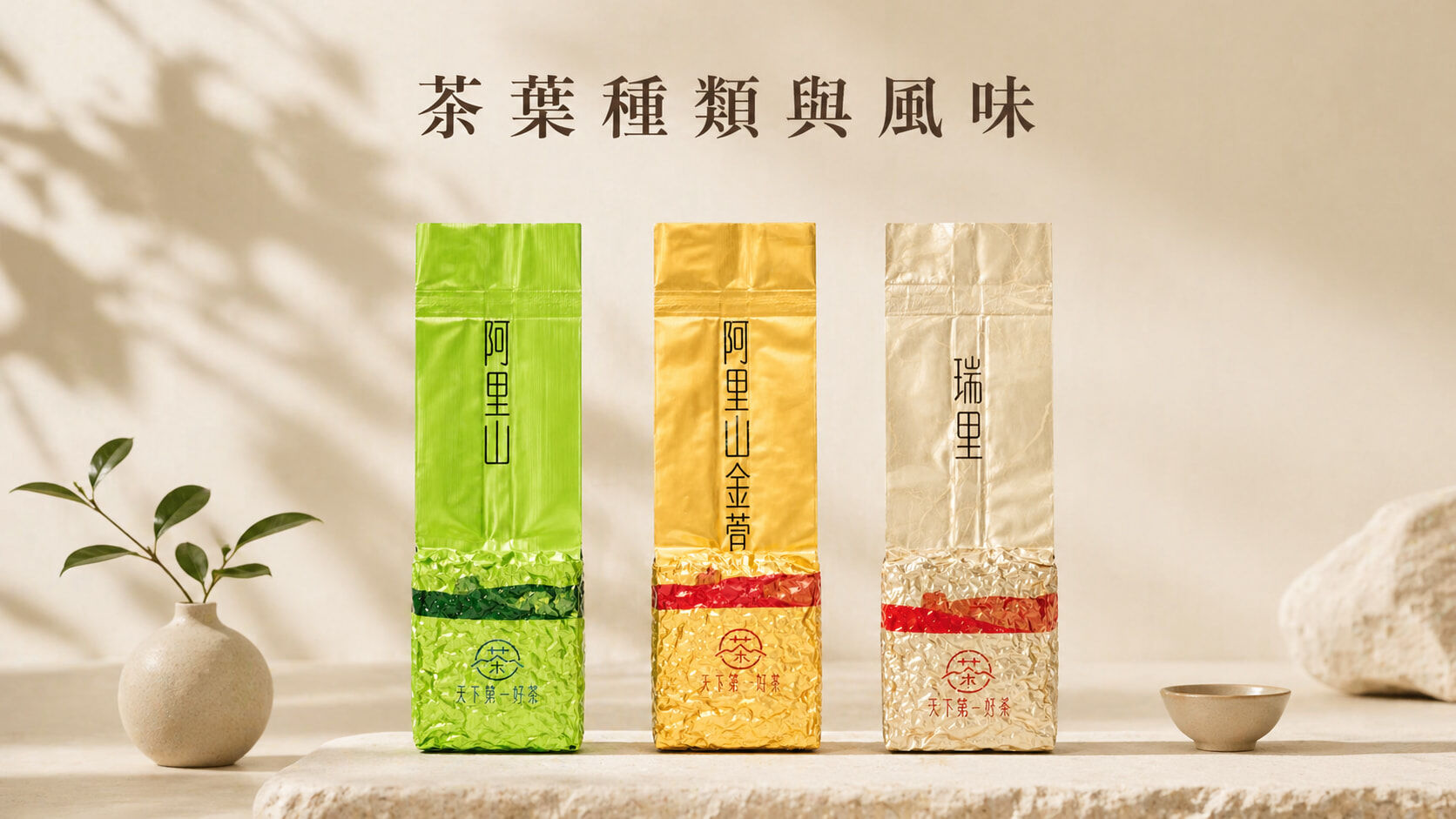
Teas from different sub-regions all carry the Alishan name, yet you can taste the difference. Our three Alishan teas all come from our own gardens: Qingxin Oolong from Zhangshuhu (about 1,500 m), Alishan Jin Xuan (about 1,500 m) and Qingxin Oolong from Ruili (about 1,250 m).
The classic Alishan cultivar. Our own gardens grow Qingxin Oolong at 1,250 to 1,500 meters, and the tea has a clear floral aroma, a little like osmanthus with a light orchid note. It tastes refreshing, and the sweetness slowly rises in the finish. Customers often call it clean, which is exactly how a high mountain tea should taste.
Jin Xuan is Taiwan Tea No. 12, a cultivar bred by Dr. Wu Zhen-duo. Its most obvious difference from Qingxin Oolong is a natural milky aroma, which comes from the cultivar itself rather than any added flavoring. It is soft and sweet, and many people new to high mountain tea start with Jin Xuan.
Besides its oolongs, Alishan also makes small amounts of Alishan black tea, fully oxidized and mostly made from Qingxin Oolong or Jin Xuan leaves. That is a different cultivar from the Ruby black tea (Taiwan Tea No. 18) of Yuchi in Nantou, and it tastes quite different too.
Its signature is a honey aroma, which develops after tea green leafhoppers bite the leaves (a mechanism similar to Oriental Beauty). The liquor is a bright orange-red, sweet and smooth without astringency, with clear fruity notes. It is mostly made in summer (May to August) and is one of the specialty black teas of Taiwan.
Who is it for? Anyone who finds black teas such as Ceylon or Assam too astringent, wants to try Taiwanese black tea, or drinks oolong and wants something different.
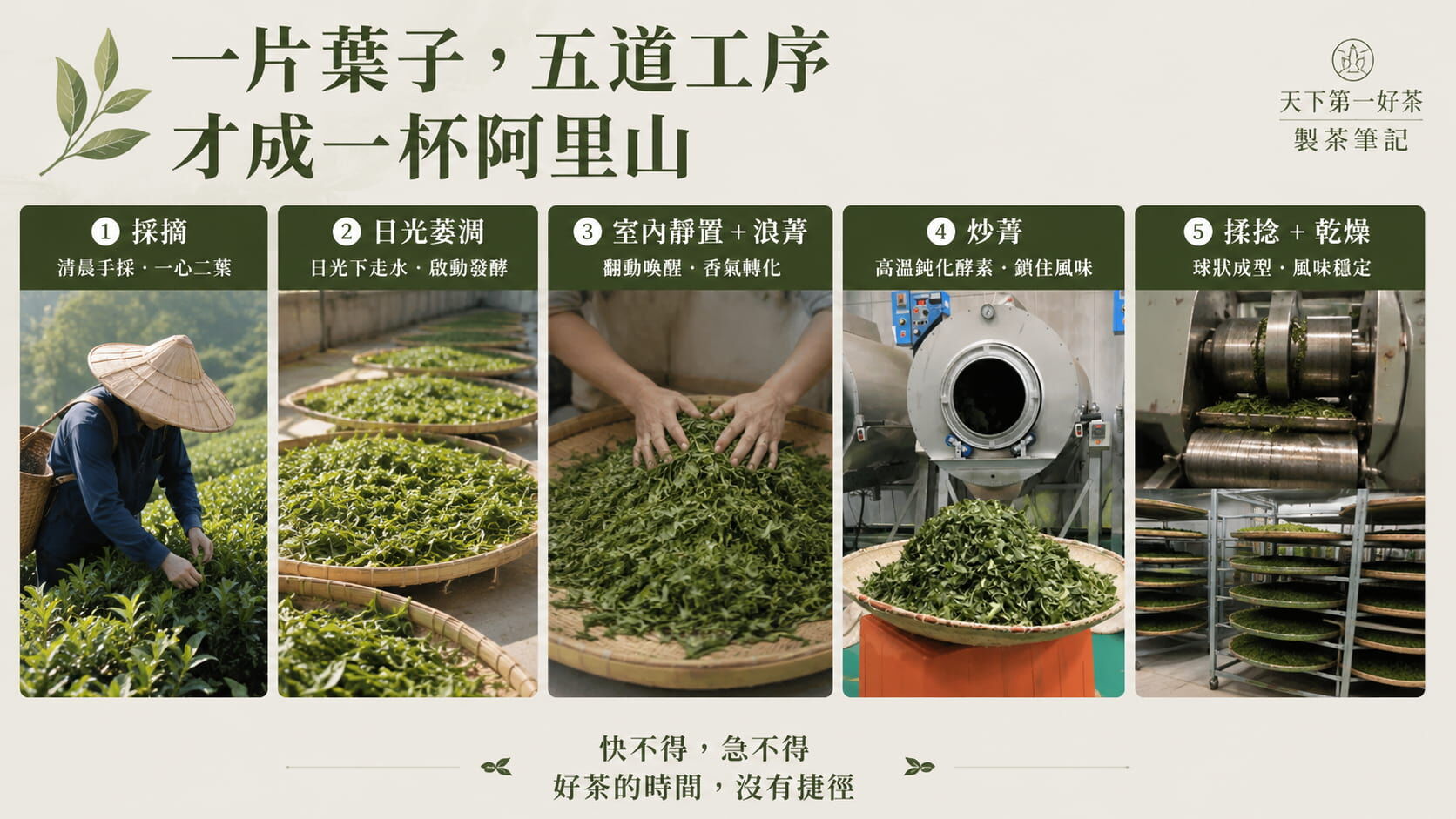
Whether Qingxin Oolong or Jin Xuan, we hand-pick one bud and two leaves. The leaves then go through sun withering, indoor resting, pan-firing, rolling and drying. The steps look much the same from tea to tea, but every judgment call shapes the result: a few minutes more of withering or a few degrees more in the pan changes the aroma. Spring tea is usually more lifted and tender; winter tea has a deeper finish and a more concentrated aroma, and each has its fans. For the whole journey from picking to brewing, read How Alishan Tea Is Grown and Made: A Complete Craft and Tasting Guide.
Want to try Alishan tea from our own gardens? Spring and winter harvests are both in stock.
See all Alishan teas →Honestly, Alishan tea prices vary a lot, from a few hundred to several thousand NT dollars per catty (600 g). What makes the difference? Mainly these factors:
| Factor | What to look at |
|---|---|
| Cultivar and grade | Qingxin Oolong usually costs more than Jin Xuan, and competition grades are priced separately. Within one cultivar, hand-picked and machine-picked tea also differ in price |
| Season | Spring and winter are the main harvests and the most consistent in quality. Other seasons yield less, and quality depends on the weather that year |
| Altitude | The higher the garden, the bigger the day-night temperature swing and the slower the leaves grow, so more aroma builds up. Tea from above 1,400 m usually costs more |
| Seller | Buying from the grower or a brand that ships direct from the origin is usually better value. The more hands the tea passes through, the higher the price, without necessarily better quality |
A simple check: look at the leaves first. Good Alishan tea is tightly rolled and dark green with a sheen. It should smell clean, with no stale or off notes. If the shop lets you taste it, check whether the sweet finish is clean; that tells you more than the price tag.
From what we have seen over the years, the most common trap is Vietnamese tea sold as Alishan tea. To avoid it, check these points:
| What to check | Good tea | Warning signs |
|---|---|---|
| Appearance | Tightly rolled half-balls, dark green with a sheen | Loose leaves, yellowish or dull in color |
| Liquor | Honey-yellow or pale gold, clear and bright | Cloudy, reddish or dark |
| Aroma | A lifted floral or gentle milky aroma, natural and never harsh | An overly strong or chemical-smelling aroma |
| Taste | Smooth with a lasting sweet finish; re-steeps 3 to 5 times | Turns thin or bitter by the 2nd or 3rd steep |
| Source | Clear origin labeling; the seller can tell you where the garden is | Vague about the origin, or a price that seems too low |
Honestly, Alishan tea is the easiest Taiwanese high mountain tea to enjoy. It is not as crisp and sharp as Lishan tea, nor as heavily roasted as Dongding oolong. If you:
then Alishan tea is a safe choice.
Alishan is a classic of Taiwanese high mountain tea, but each region tastes different because of its altitude, terrain and climate. Here are three regions as renowned as Alishan: