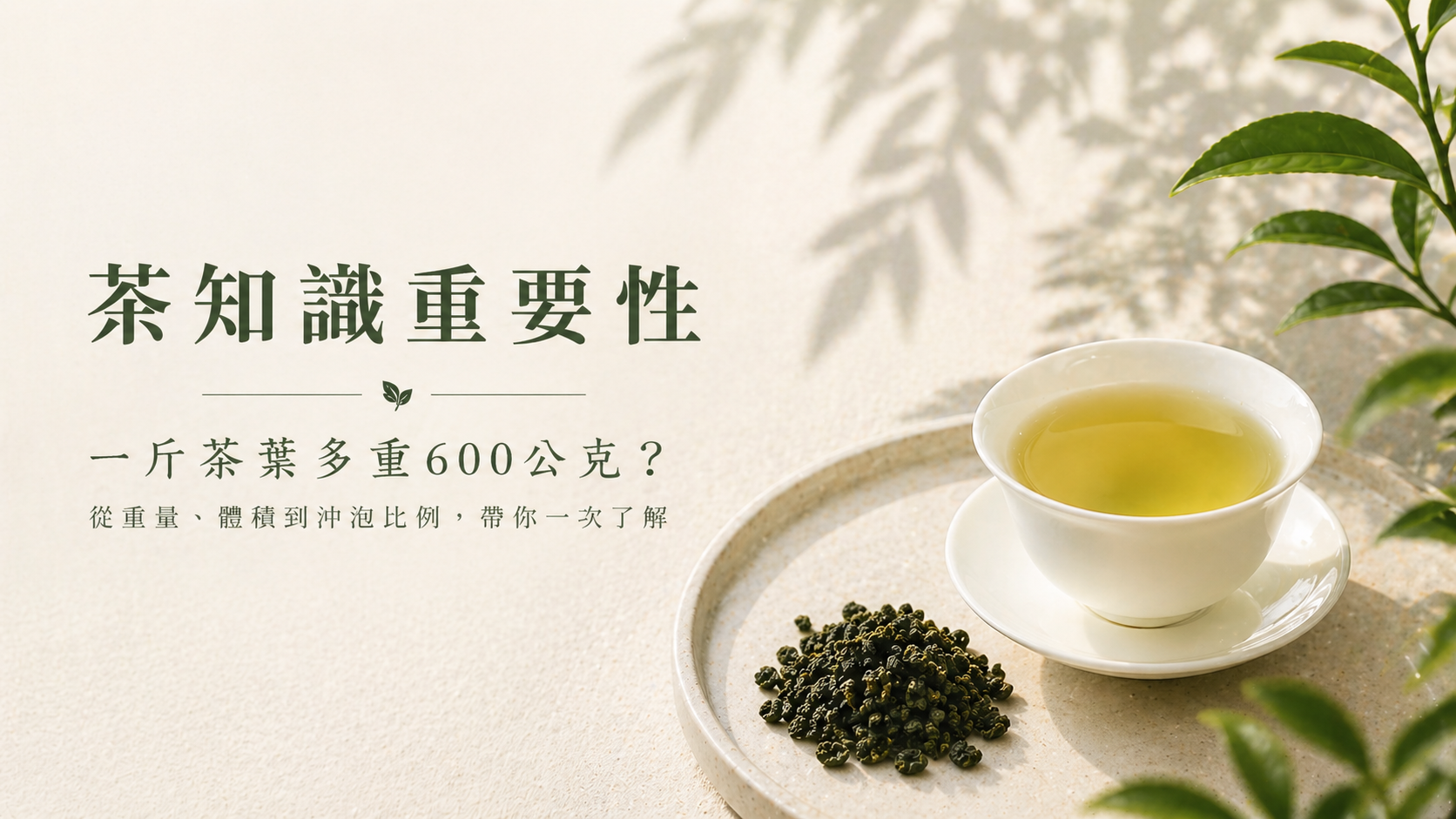
 When buying tea in Taiwan, you'll often see the unit "jin." One Taiwanese jin equals 600 grams, which differs from the Mainland Chinese jin (500 grams). This difference can easily cause confusion when purchasing tea — understanding this number is essential for accurately comparing unit prices and quantities across different brands.
CONTENTS
Key Highlights
1. How Many Grams Is One Taiwanese Jin? Common Unit Conversions
2. The Relationship Between Tea Weight & Quality
3. How to Judge Tea Freshness by Weight
4. Weight & Price Conversion
How Many Grams Is One Taiwanese Jin?
Taiwanese Jin Conversion
1 Taiwanese Jin = 600 Grams
(Mainland Chinese jin = 500 grams — be aware of this difference when buying tea across borders)
Common tea measurement conversions are as follows:
1 Taiwanese Jin
600 grams
The most common tea measurement unit in Taiwan
Half Jin
300 grams
A standard selling unit at many tea shops
1 Liang
37.5 grams
A common size for small trial purchases; 1 jin = 16 liang
75 grams
Approx. 2 liang
The standard retail packaging size for most brands
⚠ When buying tea online, take note: some Chinese tea merchants label "one jin" as 500 grams (the Mainland jin), not Taiwan's 600 grams — always verify before purchasing.
BESTEA labels every tea clearly with weight and origin information, so you can buy with confidence.
Browse All Teas → The Relationship Between Tea Weight & Quality
The idea that "heavier tea means better quality" is only half true — the reality is more nuanced:
Moisture Content
Fresh tea leaves have higher moisture content and weigh more, but improperly stored tea that has absorbed moisture also becomes heavier — "heavy" doesn't equal "fresh." You still need to check the aroma and appearance.
Processing Density
Ball-rolled oolong teas (like Alishan tea) are denser than strip-shaped teas, with a smaller volume at the same weight. This is a processing difference, not an indicator of quality.
Roast Level
Heavily roasted teas have lower moisture content, making them lighter than lightly roasted teas at the same volume. Compare Dong Ding Oolong with a lightly roasted Lishan tea — their densities differ noticeably.
Broken Leaf Ratio
Tea with a high ratio of broken leaves isn't necessarily lighter, but the brewed liquor tends to taste more bitter and astringent. When purchasing, look at leaf completeness — don't rely on weight alone.
How to Judge Tea Freshness by Weight
When buying tea, weight can serve as a reference but shouldn't be the sole criterion. The following methods are more direct:
1
Smell the Dry Leaves
Fresh tea should have a naturally clean aroma with floral, fruity, or honey notes. It should not have musty, moldy odors or overly sharp chemical smells.
2
Examine Leaf Color
Vibrant green with a healthy sheen (for oolong) or prominent white tips (for Bai Hao Oolong) indicates proper storage. Dull color and extensive leaf breakage warrant caution.
3
Check Packaging Seal
Tea stored in vacuum-sealed aluminum foil bags or airtight canisters retains freshness significantly better than loose-displayed tea.
4
Look for Pesticide Test Reports
Reputable brands typically provide SGS or other third-party pesticide residue test reports — this says far more about quality than weight alone.
Tea Weight & Price Conversion
When buying tea, converting everything to price per 100 grams makes comparison easiest:
Listed Price
Total Weight
Description
Price per 100g
1 jin NT$1,200
600g
Common Taiwan pricing
NT$200
Half jin NT$800
300g
Tea shop small pack
NT$267
75g NT$600
75g
Brand retail pack
NT$800
150g NT$950
150g
Mid-size pack
NT$633
High-Mountain Tea Price Reference
Due to limited yield and high hand-picking costs, high-mountain tea typically ranges from NT$400–1,200 per 100 grams, depending on the growing region's altitude and grade. "High-mountain tea" priced unusually low warrants extra attention to whether the origin is clearly labeled.
Taiwan High-Mountain Tea with Transparent Origin & Clear Weight
Every BESTEA tea lists its growing region, altitude, weight, and SGS pesticide residue testing information — giving you a complete basis for informed purchasing, looking beyond just weight to quality.
Q How many grams is one jin of tea in Taiwan?
One Taiwanese jin equals 600 grams. This differs from the Mainland Chinese jin (500 grams), so be sure to confirm when buying tea across borders. Common conversions: half jin = 300 grams, 1 liang = 37.5 grams, 1 jin = 16 liang.
Q Does heavier tea mean better quality?
Not necessarily. Weight is influenced by moisture content, processing method (ball-rolled vs. strip-shaped), roast level, and other factors — quality cannot be judged by weight alone. More reliable indicators include whether the aroma is naturally fresh, the leaves are intact with a healthy sheen, and whether the brand provides SGS pesticide residue test reports.
Q How do I convert tea weight into unit price?
Converting to price per 100 grams is the easiest way to compare. For example: 1 jin (600g) at NT$1,200 equals NT$200 per 100g; a 75g pack at NT$600 equals NT$800 per 100g. When units differ, always convert first — don't be misled by package size.
Q Where can I buy clearly labeled Taiwan high-mountain tea?
Every BESTEA tea lists its growing region, altitude, weight, and SGS pesticide residue testing information — covering Alishan, Lishan, Dayuling, and other origins, shipped directly from the source.
BESTEA — QUALITY YOU CAN MEASURE
See the Weight, See the Quality
BESTEA Taiwan high-mountain tea — every product labeled with origin, weight, and SGS pesticide residue certification, so you can choose clearly and drink with confidence.
KEEP READING
You Might Also Enjoy


