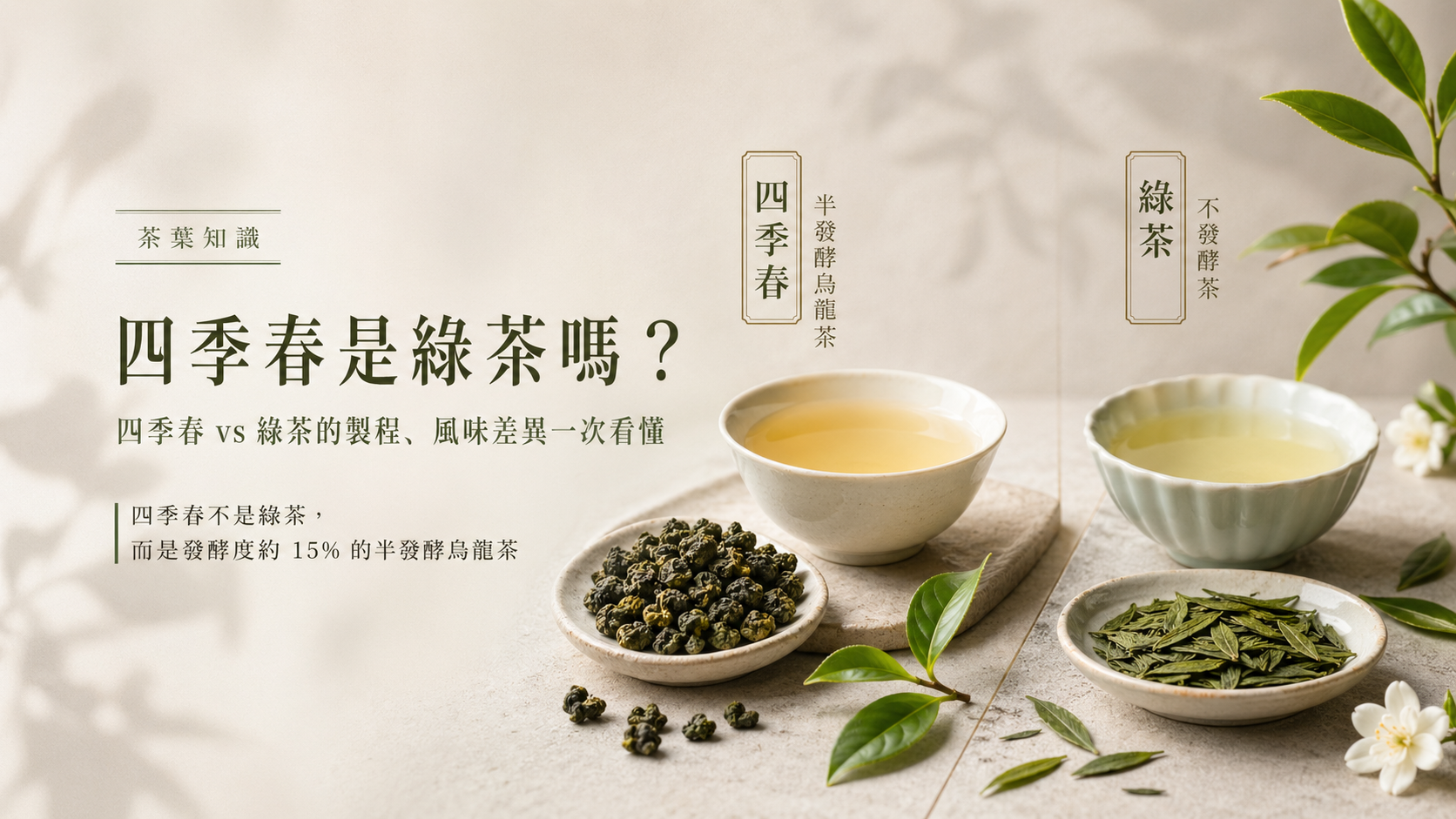
Si Ji Chun has green leaves and a fresh aroma—many people assume at first glance that it is green tea. But it is not. This article explains exactly why.
CONTENTS
Key Points of This Article
1. Is Si Ji Chun classified as green tea?
2. Production process comparison: Si Ji Chun vs green tea
3. How can you tell them apart with the naked eye?
Want to try the floral taste of Si Ji Chun right away? No need to wait until you finish reading—just drink it first.
Go to Si Ji Chun tea → Is Si Ji Chun Green Tea?
QUICK ANSWER
Si Ji Chun is a partially fermented oolong tea, not green tea. Although it has a green appearance and a fresh aroma, its production process includes withering and fermentation.
Si Ji Chun is a tea tree cultivar from Taiwan, named for the fact that it can be harvested throughout all four seasons. Although it has a green appearance and a fresh aroma, it does not belong to green tea. It is instead a partially fermented oolong tea.
Si Ji Chun is most commonly made as a lightly fragrant oolong tea, with a noticeable floral aroma and a gentle taste. It is often mistaken for green tea because its color and aroma resemble it in some ways—but the production process is completely different.
Production Process Comparison: Si Ji Chun vs Green Tea
Comparison Item
Si Ji Chun (oolong tea category)
Green Tea (unfermented tea)
Fermentation level
A partially fermented tea, commonly made in a lightly fragrant oolong style
An unfermented tea that emphasizes preserving fresh original flavor
Production steps
Withering → Tossing → Kill-green → Rolling → Roasting
Kill-green → Rolling → Drying
Aroma profile
Fresh fragrance, floral aroma, fruity aroma
Bean-like aroma, grassy aroma, sweet freshness
Taste
Gentle, sweet, and rounded
Fresh and lively, slightly bitter but with a quick sweet return
Leaf appearance
Thicker, dark green in color, curled in shape
Thinner, lighter in color, often flatter in shape
Si Ji Chun vs green tea—the clearest way is to brew both and compare
No matter how much text you read, it is still better to taste them yourself. BESTEA offers both Si Ji Chun oolong and Sanxia Bi Luo Chun green tea—brew the two together and you will immediately feel the difference.
Si Ji Chun vs Green Tea: How can you tell with the naked eye?
If you see a label like “Si Ji Chun green tea” in a shop or online, you can quickly judge it from three angles:
Out
Appearance
Si Ji Chun leaves are thicker, dark green, and curled in shape. Green tea leaves are thinner, lighter in color, and often flatter.
Pro
Production method
Si Ji Chun includes fermentation and roasting steps, while green tea is an unfermented tea.
Fla
Flavor (the most direct)
Si Ji Chun leans toward floral and lightly roasted aromas, with a gentle sweetness on the palate. Green tea leans toward herbal and bean-like notes, with a fresh, slightly bitter profile.
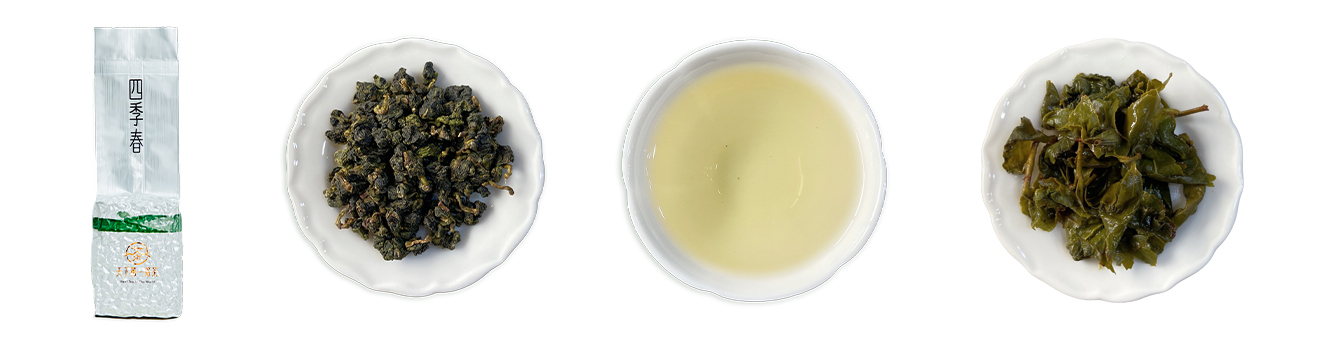
Si Ji Chun has a noticeable floral aroma and a low entry barrier, making it very suitable for first-time Taiwanese tea drinkers.
Try Si Ji Chun directly → Conclusion: Si Ji Chun is oolong tea, not green tea
Si Ji Chun is a type of Taiwanese oolong tea, belonging to the partially fermented category, with a flavor that sits somewhere between green tea and traditional oolong. Once you understand this, the experience of drinking it becomes clearer—its floral aroma and sweetness are exactly what make Si Ji Chun so charming as an oolong tea, and they point in a different flavor direction from green tea.
Gentle floral aroma, no harsh bitterness, and enjoyable throughout all four seasons—Si Ji Chun is where many people begin to fall in love with Taiwanese tea. If you have never tried it, this is a very worthwhile place to start.
FREQUENTLY ASKED
Frequently Asked Questions
Q Is Si Ji Chun green tea?
No. Si Ji Chun is a partially fermented tea and belongs to the oolong tea category. Although it has a green appearance and a fresh aroma, its production process includes withering and fermentation, making it completely different from green tea.
Q How does the production process of Si Ji Chun differ from green tea?
Green tea is an unfermented tea, and its production process usually includes kill-green, rolling, and drying. Si Ji Chun, by contrast, goes through withering, light fermentation, and roasting, so its flavor has more layers than green tea.
Q How do you tell Si Ji Chun apart from green tea?
You can observe three aspects: Si Ji Chun has a more obvious floral-fruity aroma, a clear golden-yellow liquor, and thicker curled leaves; green tea has a fresher, more herbal aroma, a greener liquor, and flatter, thinner leaves. One sip will show the difference—Si Ji Chun is gentle and sweet, while green tea is fresh with a slight bitterness.
Q Is the caffeine content of Si Ji Chun high?
Si Ji Chun belongs to the oolong tea category, and its caffeine profile usually sits between lighter and stronger teas; the actual level still varies depending on leaf tenderness and brewing method. If you are more sensitive to caffeine, you can also switch to cold brew after 3 p.m., which usually results in a cleaner overall taste.
Q Where can I buy authentic Si Ji Chun?
BESTEA offers Si Ji Chun sourced from Taiwanese tea gardens, available in both loose leaf and tea bag formats. If you are not sure how to choose, you can also start with a tea set first.
FIND YOUR FLAVOR
Start discovering Taiwanese tea with Si Ji Chun
Gentle floral aroma and a sweet first sip—Si Ji Chun is where many people begin to fall in love with Taiwanese tea. BESTEA carefully selects Si Ji Chun from Taiwanese tea gardens, letting you taste floral fragrance and sweetness from the very first cup.
KEEP READING
You May Also Like


